Archive | 2011

Kota Chakra

2 Jun

Kota Chakra

Introduction

Vedic astrology has proved that transiting planets  have profound impact on every individual in their day to day life.  Janma Nakshatra or Birth star has an important place in ones chart and often has been used as the starting point for predictions resulting from transiting planets.

Kota Chakra is one such tool which can be used to predict the good & bad happenings in one’s life resulting from transiting planets at a particular moment of time.

Kota (कोट) is a Sanskrit word, means fort. Kota Chakra is fundamentally a diagram depicting transit routes of planets through 28 Nakshatras, including Abhijit.

Purpose of Kota Chakra

In ancient times, Kota Chakra was erected for a designated time to predict the outcome of war / battle and the result of fighting between two warlords. In today’s context the chart provides information regarding professional setback, transfer, termination, failure and fall from the position, bodily discomfort, outcome of a dispute or lawsuit, destruction and death.

 Construction of Kota Chakra

Kota Chakra, also known as Durga Chakra (दुर्गा चक्र), is a quadrangle diagram comprising four divisions. Two small squares inside expands into a large square that forms three segments, while fourth segment is the outer boundary of large square.

The figures are divided into two halves by a vertical straight line or a pair of straight lines :these are then further divided into two – and thereby resulting in four quarters – by a horizontal straight line or a pair of straight lines. Thereafter, two diagonal straight lines or two pairs of straight lines are used for making further divisions. Thus the chart is divided into 8 parts. Please see the figure below for better understanding.  

The placement of 28 Nakshatra in Kota Chakra always begins with Janma Nakshatra, which is placed in the North Eastern corner of diagram.

Kota Chakra is divided into four sections as follows:

  • Stambha (Innermost Portion)
  • Durgantara or Madhya (Inner-Middle Portion)
  • Prakaara (Boundary Wall)
  • Bahya (Exterior of the Fort)

Stambha:

Stambha literally means pillar that support a building. In Kota Chakra, it is the central courtyard. This innermost portion of the Kota Chakra is indicated as green coloured box in above figure. Counting from Janma Nakshatra; 4th, 11th, 18th and 25th constellation falls in this division. If a native’s Janma Nakshatra is Rohini then Punarvasu, Chitra, Uttarashada, and Revati form the Stambha Bhaga of his Kota Chakra.

Durgantara or Madhya:

It lies in between inner and outer divisions of Kota Chakra. 3rd, 5th, 10th, 12th, 17th, 19th, 24th, and 26th Nakshatra from Janma Nakshatra falls in this portion. Following this distribution, if Rohini is the Janma Nakshatra then Ardra, Pushya, Hasta, Swati, Purvashadha, Abhijit, Uttarabhadra and Aswini constitute Madhya Bhaga or Durgantara.

Prakaara:

Prakaara is generally the outer boundary, edge or walls. This portion of Kota Chakra is depicted here in pinkish red colour.  Counting from Janma Nakshatra, 2nd, 6th, 9th, 13th, 16th, 20th, 23rd, and 27th Nakshatra is placed in this division of Kota Chakra. If someone is born in Rohini Nakshatra then Mrigashira, Aslesha, Uttaraphalguni, Visakha, Moola, Sravana, Purvabhadra, and Bharani form Prakaara Bhaga.

Bahya

Bahya means outside boundary. This outermost division is the portion that surrounds the rest of Kota. Bahya Bhaga comprises 1st, 7th, 8th, 14th, 15th, 21st, 22nd, and 28th lunar constellation from Janma Nakshatra. Following this if somebody is born with Rohini Janma Nakshatra, the Rohini, Magha, Purvaphalguni, Anuradha, Jyeshta, Dhanista, Satabhisha, and Krittika lie in this area.

                                                             Terminologies

Kota Swami:

Kota Swami is also referred to as Durgapati. It literally means Lord of the Fort. Kota Swami is simply the Lord of the Rashi in which the natal Moon is posited. For example, if someone was born with Moon in Taurus then Venus should be his Kota Swami of Kota Chakra.

Kota Paala

Kota Paala literally means Guard of the Ford. Paala also signifies one who tends and cares. Finding Kota Paala is bit difficult and cumbersome. Kota Paala is the lord of Pada of Janma Nakshatra as per Avakahada Chakra (आवकहदग चक्र) and is the planet representing the initial sound /first letter of the native’s name.

Entry Path

If you look at the Kota Chakra and the order of placement of Nakshatra, it will appear as though the stars are entering through semi-cardinal points, namely, NE, SE, SW & NW and converging at Stambha. These four ingress routes are called ‘Entry Path’

Exit Path

Similarly the route of Nakshatra appears as though they are exiting from Stambha towards cardinal points, namely, E, S, W & N. These four egress routes are called ‘Exit Path’

Example

Kota Chakra generated for Bangalore at 1800 hrs on 02 June 2011  for native born on 6th February 1985. His Moon was in Leo / Magha 3rd Pada and hence his Kota Swami is Sun. Kota Paala is Saturn.

Kota Chakra for Bangalore at 1800 hrs on 02 June 2011 for a native born 6th Feb 1985

Simple Thumb Rule to interpret Kota Chakra

  • The ‘Stambha’ and the ‘Madhya’ regions constitute heart of the Kota Chakra. Natural and functional benefic planets in this area indicate  strength and ability to face adverse impacts; natural and functional malefic planets may do the reverse.
  • The ‘Prakaara’ and ‘Bahya’ regions represent the circumstances and surroundings. Natural and functional malefic planets indicate adverse circumstances but natural and functional benefic planets indicate improved condition.
  • If natural malefic planets transit through the Nakshatras that are placed on the course of “Entry Path” and at the same time, natural benefic planets transit on “Exit Path” forms Durga Bhanga (दुर्गाभगांर्) yoga. This yoga indicates defeat.
  • If natural benefic planets are on the “Entry Path” and natural malefic planets are on the “Exit Path” then one wins the battle.
  • Auspicious results accrue when Kota Swami transits Madhya Bhaga or Durgantara, and Kota Paala transits Bahya Bhaga.
  • If fast moving planets like Moon, Mercury, or Venus becomes the Kota Swami or Kota Paala, and transits through adverse positions, they may not do much harm  due to their fast movement. But if Saturn happens to be a Kota Swami or Kota Paala, and transits through these positions , then it is a matter for concern.
  • Rahu & Ketu are always retrograde and therefore the ‘entry’ becomes ‘exit’ and vice versa. Similar is the case for ‘Retrograde’ planets.
  • Commencement of “Retrogression” of any planet is always bad. In case of natural malefic planets, it is indicative of accidental mishap, untoward happening, etc; and in case of natural benefic planets, it signifies withdrawal of support or protection.

Author’s Note

This is a vast subject and requires extensive reading and research. I have endeavoured to give a glimpse of the same and serious students of astrology are advised to go through the following classics / books for a comprehensive understanding of the subject.

  • Brihat Parashara Hora Shastra
  • Daivajna Vallabha by Varahamihira
  • Uttrakalamrita by Kalidasa
  • Astrological Applications of Kota Chakra by KK Joshi
  • The mystery of Kota Chakra unraveled by KN Rao

Caution

Like any other method used for transit prediction, the result obtained from this method also has to be corroborated by the Dasha – Bhukti currently running for the native. Therefore do not be hasty in coming to conclusion using results of this method only. If Dasha – Bhukti is good, many results may have to be moderated or  some of them may not even happen.

Avasthas – Sanketanidhi

31 May

‘Om Gurubyo Namaha

Om

Sanketanidhi (Treasure of learning) is a book of essence of knowledge extracted from various classics on Hindu astrology by Shri Ram Dayalu, an astrologer, for the benefit of his nephew Shri Ghasi Ram (son of Ram Dayalu’s eldest brother Shri Vazir Chand Sharma) so that he can become proficient in astrology.

In Chapter (Sanketa) V, he describes various Avasthas, method of calculation and the result of planets placed in that Avasthas. I shall summarise the process in following paragraphs.

Nomenclature

There are 12 Avasthas the names of which are as follows:

  • Shayana or lying down
  • Upaveshana or sitting
  • Netrapani or with a hand on the eye,
  • Prakasha or shining
  • Gamana or going
  • Agama or not going
  • Aasthanee /Sabha or attendance in assembly
  • Aagama or coming
  • Bhuji /Bhojana or eating
  • Nrityalipsa or desire to dance
  • Kautuka or curiousity
  • Nidra or sleep.

Methodology /steps in calculation of Avasthas of Planets

Sanketanidhi recommends the following method:

  • Note the planetary number of the planet (Sun 1, Moon 2, Mars 3, Mercury 4, Jupiter 5, Venus 6, Saturn 7, Rahu 8 and Ketu 9)
  • Find the number of star (reckoned from Aswini) occupied by the planet.
  • Find the product of two above. Call it ‘A’
  • Find the degree occupied by the planet in the sign and multiply this by “A”
  • Call this product “B”
  • To this product (“B”) add the following
    • The number of the natal star (reckoned) from Ashwini
    • The number of Ghatis at birth counted from the previous sun rise (Note: One Hour = 2.5 Ghatis, One Min = 2.5 V Ghatis)
    • The number of Ascendant counted from Aries.
    • The resulting sum should be divided by 12.
    • The remainder represents the number of the Avastha counted from Shayana.

 Brihat Parashara Hour Shastra recommends the following method for finding out the Avasthas of planets. I advise students to adopt this method because, it is simpler than the one mentioned above.

  • Find the number of star (reckoned from Aswini) occupied by the planet.
  • Multiply this by the planetary number (Sun 1, Moon 2, Mars 3, Mercury 4, Jupiter 5, Venus 6, Saturn 7, Rahu 8 and Ketu 9) – Call this product “A”
  • Multiply “A” by the number of Navamsha occupied by the planet. Call this product “B”
  • To “B” add the number of Star occupied by the Moon in Rashi Chart (Janma Nakshatra)……Call this product “C”
  • To “C” add the number of Ascendant counting from Aries. Call this “D”
  • Divide “D” by 12 and note down the remainder.
  • Remainder indicates Avastha of the planet
  • Note: Remainder Zero is taken as 12.

Example


Rashi Chart

To find Avastha of Mercury

Mercury is in Krittika 2 Pada – 3rd Star from Aswini

Planetary Number is 4

Mercury in 1st Navamsha

Natal Moon is in Krittika 1 Pada – 3rd Star from Aswini

Asc is 5th from Aries

Therefore Avastha = 3X4X1=12+3+5=20

20 divided by 12 gives a remainder of 8

8 represent ‘Aagama’ Avastha


Effects of Planets in various Avasthas

Sun:

Shayana: Ulcer or wound in anus, pain or some other trouble in chest, fear from father, loss of wealth. Upaveshana: Wicked thoughts in mind and enmity with others. Netrapani: Plenty of happiness, gain of wealth from the king or government. Prakasha: Liberal minded, honour and happiness. Gamana: Lazy, impure, unhappy, angry, illicit relations with other women. Agama: Attached to other peoples wives, passionate, wicked, defamed. Aasthanee: Member of assemblies, helping others, forgives others easily. Aagama: Weak, harassed and defeated by enemies, wicked, unstable mind, fond of intoxicants. Bhuji: Worried, evil minded, miserable, loss of wealth. Nrityalipsa: Happy, honoured by assembly of nobles. Kautuka: Conquest over enemies, honoured by king or government. Nidra:-Bereft of wife and wealth, very lazy.

Moon

Shayana: Stupid, poor. Upaveshana: Thief, sickly, stupid. Netrapani: Speaks harshly, rogue. Prakasha: Equipped with good qualities, favourite of the king or government, always happy. Gamana: Suffers from eye trouble even if Moon is in Shukla Paksha (waxing). Agama: Poverty, suffers from diseases of the feet. Aasthanee: Like a king, fond of women. Aagama: Waxing Moon is auspicious but if waning, the native would be sickly. Bhuji: Many kinds of comforts and happiness if Moon be Waxing. Waning Moon gives inauspicious results. Nrityalipsa: Enjoys charming music if the birth be in Shukla Paksha (bright half). It would not be so in the Krishna Paksha (dark half). Kautuka: King of kings, clever, wealthy and fond of all kinds of luxuries, women etc. Nidra: Would command honour and respect if Moon be associated with Jupiter. It would not be so if Moon be with Rahu.

Mars

Shayana: The native suffers from skin diseases like ring worm, itches herpes, etc. Upaveshana:  Sinful, wealthy but of perverted mind. Netrapani-If Mars be in a house other than Ascendant and be in this Avastha, the native would become the chief official of the town. Prakasha: The native would become a king if Mars in this Avastha be in a house other than the 5th and be associated with Jupiter. Gamana: Quarrels, troubles, unhappiness, fear, loss of wealth. Agama: Receives love and affection from others, happy, conquest over enemies with great effort. Aasthanee (Sabha): The native would indulge in sinful acts if Mars in this Avastha be in 9th, the 5th and the 12th house. His cherished desires would be fulfilled if it be posited in other houses. Aagama: Evil minded, sinful, sickly. Bhojan: Sinful, fond of sweet things. Nrityalipsa: Happy in every respect. Kautuka: Blessed by friends, children and wealth. Nidra: Poor, hot-tempered, troubled, impure.

Mercury

Shayana: Crippled, red eyes. If Mercury be posited in a house other than Ascendant, the native would be stupid. Upaveshana: If Mercury, while in this Avastha, be posited in its friendly or exaltation sign, the native would be fortunate. If Mercury be associated with or aspected by malefics, the native would be poor. Netrapani: If Mercury, while in this Avastha, be posited in 5th house, the native would be issueless, unsteady but very intelligent. Prakasha: Lord, learned, destroyer of wicked people, kindly, sympathetic, clean hearted and happy. Gamana: Gets happiness from the king or government. Agama: Wealthy and builder of beautiful houses. Sabha: If Mercury, while in this Avastha be in its sign of exaltation, the native would get all round happiness. Aagama: Famous, father of twins. Bhojana: Quarrelsome, mischievously inclined, thin and lean. He would also be fond of prostitutes. Nrityalipsa:  All happiness, very wealthy. Kautuka: If Mercury, while in this Avastha, be posited in Ascendant or 9th house, it would be very auspicious for the native. If Mercury be posited in 7th or 8th house, the native would seek pleasure from prostitutes.

Jupiter

Shayana: Fair complexion, fear of enemies. Upaveshana: Talkative, proud, would suffer on account of enemies, would be punished by the king (government), would have ulcers or wounds. Netrapani: Sickly, poor, addicted to women of the prohibited class, always inclined towards sensual pleasures. Prakasha: Passionate, brilliant, devotee of God Vishnu, very rich. Gamana: Blessed with many friends, children and wealth. Agama: Famous all over the country for good qualities, unlimited wealth, very learned eager. Sabha: Honoured and wealthy. Aagama: Like a king, honoured many relations dependents and servants; would enjoy all happiness. Bhojana: Fond of sweets, many brothers, wealthy. Nrityalipsa: Would be able to understand the true nature of Brahman, would be opulent. Kautuka: Respected by brothers and relations. Nidra: Perverted, poor, not charitably inclined.

Venus

Shayana:  Dental troubles, dishonored. Upaveshana: Respected by government, happy, destroyer of enemy. Netrapani: While in this Avastha if Venus be in 10th, 7th or 6th house, the native would be deprived of his eye sight. Prakasha: The native would become a great man if Venus be posited in its own, exaltation or a friendly sign. Gamana: Native would act against the wishes of his mother and suffer from diseases. Sabha: Like a king, conquest over enemies famed for his good qualities. Aagama: Benefit of wife, children and wealth, sickly. Bhojan: -suffers from hunger, enemy and diseases. Nrityalipsa: Intelligent, wealthy. Kautuka: becomes an important person, wealthy, respected. Nidra: defamed, dumb and deaf.

Saturn

Shayana: Suffers from hunger and thirst, hard working, sickly in first portion of life and happy in the latter portion. Upaveshana: Proud, gets imprisonment as a result of wrath of government, suffers from tuberculosis. Netrapani: Very wealthy, owns lands, very patient and satisfied, has good knowledge of arts. Prakasha: Devotee of Goddess Parvati and Lord Shiva, clever, wise, intelligent, sympathetic, happy. Gamana: Wealthy, happiness from relations, capable. Agama: Bereft of children, sickly, would be roaming about alone. Sabha: Wealthy, happy, brilliant. Aagama-Sickly, idiot, belongs to low caste, bereft of enjoyment. Bhojan: would get richly flavoured meals, would suffer from eye trouble. Nrityalipsa: Wealthy, charitable. Kautuka: Would have the pleasure of enjoying dance and music by young beautiful girls. Nidra: Would become a great personage of all tastes, capable of enjoying several merits in them, and would be happy.

Rahu

Shayana: While being posited in Taurus, Gemini, Aries or Virgo, if Rahu be in Shayanavastha, the native would be wealthy. Rahu’s position in other signs would bring about unfavourable results for the native. Upaveshana: The native would be penniless though favoured by the king or government. Netrapani: Fear from thieves, serpents, enemies, rogues, loss of wealth, eye trouble. Prakasha: Famous, like a king, good qualities, wealthy, dark in appearance, lucky. Gamana: -Happy, intelligent, good children, honoured by the king or government. Agama: Does not receive affection or love, sickly, angry temperament, rogue. Sabha: Learned, wealthy but miserly, good qualities. Aagama: Differences with relations fall from high position as a result of some conspiracy by enemies. Bhojana: Suffers from hunger and separation from his family members. Nrityalipsa: Eye-trouble and danger from enemies. Kautuka: Thief has illicit relations with other women. Nidra: Good wife and children

Ketu

The effects of Ketu in different Avasthas would be the same as those of Rahu.


Author’s Note

The latter half of this Chapter V describes the effects of planets in certain Avasthas as a result of the following

  • the planets occupying particular houses
  • Aspect received by them from other planets in a birth chart.

Those interested in further research are advised to go through this Chapter in detail.

June Panchanga

29 May

June 2011 – Monthly Panchanga

   Khara Samvatsara – Uttarayana

    Greeshma Ritu – Jyeshta Masa

Important events for the month of June is appended below for information and guidance

01 Jun 2011

  • New Moon
  •  Solar Eclipse
  •  Not visible in India

04 Jun 2011

  • Venus enters Taurus. Venus is good in all places except 6 &10 from natal Moon

06 Jun 2011

  • Rahu enters Scorpio & Ketu enters Taurus. Both are good in 3, 6 & 11th from natal Moon

12 Jun 2011

  • Mars enters Taurus. Mars is good in 3, 6 & 11th from natal Moon
  • Saturn turns direct

13 Jun 2011

  • Soma Pradhosha

14 Jun 2011

  • Mercury enters Gemini. Mercury is good in 2, 4, 6, 8, 10 & 11 from natal Moon
  • Narasimha Jayanthi (Solar)

15 Jun 2011

  • Sun enters Gemini. Sun is good in 3,6,10 & 11 from natal Moon
  • Full Moon
  • Satyanarayana Pooja
  • Lunar Eclipse (Rahugrastha)
  • Visible in India
  • Start time: 2315 hours IST
  • Mid time: 0143/ 16th June
  • End time:0333 / 16th June
  • Total duration: 3 hrs 40 min
  • Affected Nakshatra / Rashi: Jyeshta /Vrischika & Moola / Dhanu Rashi

19 Jun 2011

  • Sankasta Chaturthi

28 Jun 2011

  • Mercury enters Cancer. Mercury is good in 2, 4, 6, 8, 10 & 11 from natal Moon
  • Maha Pradhosha

29 Jun 2011

  • Venus enters Gemini. Venus is good in all places except 6 &10 from natal Moon


Disclaimer: This Almanac is published as an advisory only. Individuals are requested to use their Free will / discretion and consequently the author is not responsible for any damage / loss suffered by them.

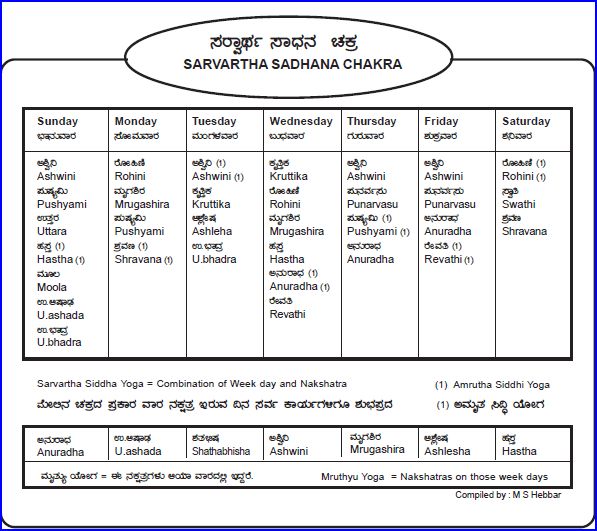
Sarvartha Sadhana Chakra

25 May


Drekkana

19 May

Om Gurubyo Namaha

Drekkana / Dreshkana / Decante

In Vedic Astrology it is referred as  Drekkana /Dreshkana (mostly Drekkana) and is 1/3 of a sign equal to 10 degrees: there are three Drekkana in each sign. Drekkana holds an important position in divisional charts. Various ancient and classical texts have mentioned different methods of calculating Drekkana. Generally known Drekkana (D3) are as follows:-

1. Parashara Drekkana

2. Jagannath Drekkana

3. Somanath Drekkana

4. Privritti-traya Drekkana

Parashara Drekkana: This is the most commonly used Drekkana in Vedic astrology. In fact when you read about Drekkana anywhere without specific reference then it is understood that it this Drekkana. Parashara Drekkana is used to know about the sibling of a person and analyzing all matters related to co-borns

Jagannath Drekkana: This Drekkana reflects karma of previous life of a person.  D-60 must be analysed along with it.

Somnath Drekkana: Somnath Drekkana is used to know about the sexual drive of a person and describes the attitude of a person towards the sexual matters and his libido. This is generally used in Prashna Jyothisha

Privritti-traya Drekkana: This chart is used to see the drives and initiatives that the person apply to achieve his goals. This is generally used in Prashna Jyothisha

Parashara Drekkana

Generally the first Drekkana of any sign is ruled by the owning planet, second Drekkana by the 5th lord and the third Drekkana by the 9th lord. For example, the first Drekkana of Aries is ruled by Mars, the second Drekkana is owned by Sun and the third Drekkana is owned by Jupiter.

Sage Parashara named three sages as lords of three Drekkana of each sign as follows:-

For Movable Signs:  Aries, Cancer, Libra & Capricorn – Narada, Aghastya and Durvaasa

For Fixed Signs: Taurus, Leo, Scorpio & Aquarius – Aghastya, Durvaasa and Narada

For Dual Signs: Gemini, Virgo, Sagittarius & Pisces- Durvaasa, Narada & Aghastya

Significance of Lordship

Narada Muni was known for his ‘Bhakti’ (Devotion) to the Supreme Lord. Bhakti is the prime necessity of the soul; therefore Narada might represent the Atma, or the soul. Aghastya Muni is associated with mind in many places in the Vedas. Durvaasa Muni was famous for his efforts to control his senses, therefore he represents the Indriyas, or senses. So we might say that the three Drekkanas of the signs may refer to the soul, the mind and the senses.

Parashara states that the Drekkana Chart should be used to analyze relationship with siblings, or co-borns. We might conclude that the planets in the Drekkanas ruled by Narada would denote the spiritual/karmic relations to the native’s brothers. Those in the Drekkanas ruled by Aghastya would signify the mental/psychological effects from brothers, and those in the Drekkanas ruled by Durvaasa would refer to the sensual/physical comfort or discomfort caused by the brothers and sisters.

General use of Drekkana

Apart from its use to analyse the information related to the co-borns / siblings, Drekkana is also used for following purposes

  • In the context of Lost Horoscopy when the time of birth or time of conception is unknown, through horary method the lost birth details can be traced. The effects of ten divisions (Dashavarga) will help to arrive at the natal Ascendant.
  • Drekkana of your ascendant gives an insight into your personality, behaviour and other important attributes.
  • Details of all 36 Drekkana covering 12 signs are available in Chapter 50 of Kalyana Varma’s ‘Saravali’
  • 22nd Drekkana is called Khara and its lord is known as Kharesh.22nd Drekkana is considered one of the first-ranked malefic planet for the native and gives clue to his death.
  • The effects / nature of death for each Drekkana for 12 signs are explained in Chapter 47 titled ‘Aphorisms  of death ‘in Kalyana Varma’s ‘Saravali”
  • Drekkanas have an important role in Prashna astrology, especially Medical Astrology.
  • The classical work on Prashna astrology “Krishneeyam” gives details of methods of using Drekkana significations in horary astrology.

Method of calculating 22nd Drekkana

There are 36 Drekkanas; 3 for each of the 12 Rashis. From the Lagna Drekkana in your horoscope, count successively till the 22nd Drekkana. For example if your Lagna is in the first 10 degrees you are born in the first Drekkana. From that count the number of Drekkanas for each Rashi. So, in this case, the 22nd Drekkana will be the 1st Drekkana of the 8th house for your horoscope; if your birth in the second Drekkana i.e. between 10 and 20 deg. of a sign, the 22nd Drekkana will fall in the 2nd Drekkana of the 8th sign; if your birth is in the third Drekkana, the 22nd Drekkana will be in the 3rd Drekkana of the 8th sign from your Lagna. The 22nd Drekkana is also called the “Niryaana Drekkana”

There are various methods of counting 22nd Drekkana, but a  short cut technique is to look  for the lord of 8th house in D-3. That planet would be lord of 22nd Drekkana for your chart.

Notes on 22nd Drekkana

Brihat Parashara Hora Shastra states that in natal astrology, the nature of the 22nd Drekkana indicates the source/ manner of death. In general condition when Longevity is not at its end, it is concerned with bodily discomfort and health matters.

Some of the special effects are as follows:

  • Occupation of natural malefic in 22nd Drekkana, in Rashi, reduces the potential of the chart up to a great extent.
  •  Ayudha Drekkana indicates injury with weapons as cause of death / accidents.
  • Sarpa Drekkana  mean danger from poisonous reptiles that could be life threatening.
  • Dasha/Bhukti of lord of 22nd Drekkana generally afflicts native’s health and yield mental agony, when devoid of benefic aspects. If the concerned planet is also a natural malefic and posited in malefic Rashi then intensity of evil would definitely be higher than expected.
  • Whenever lord of Lagna transits the 22nd Drekkana, loss, bodily discomfort, grief and quarrel will result.
  • Similarly, transit of lord of 22nd Drekkana in ascendant produces trouble regarding significance of 1st house.
  • Like ascendant, obtain 22nd Drekkanas of other planets specially Moon and Sun. Transit of that planet into respective 22nd Drekkana always mar the significance of planet transited.
  • Avoid starting any new task when your luminaries are transiting their 22nd Drekkana or/and Kharesh moving over Sun or Moon.

General points

  • If the Lagna Drekkana is Pasha Drekkana, then the native may experience bondage/ incarceration.
  • If the birth is in Chatushpada Drekkana (quadruped Drekkana) or if
    the 7th lord is in the Chatushpada Drekkana, then the sexual activity of
    the native will resemble that of a quadruped.
  • This has been explained in detail in various classics including Brihat Parashara Hora Shastra, Sarvartha Chintamani and Saravali.
  • Details about Sarpa, Ayudha, Pakshi, Pasha, Nigala and Chatushpada Drekkanas can be found in Chapter XII, ’Concerning Eight House’ in ‘How to Judge a Horoscope – Volume Two’ by Sri BV Raman

Western Connection

 Western astrology uses Decante technically identical to Jagannath Drekkana, in order to assess native’s character. Among Sun, Moon and Ascendant if all three or two fall into Decante of malefic planets then the native would be evil minded, sinner and wrathful. If trend is mixed then native will be lazy, back biter and ill-behaved. But if all three (among Sun, Moon and Ascendant) rises in benefic Decante (and their lord of Decante are also powerful) then native would be blessed, intelligent, soft spoken and successful.

Author’s Note

I generally use Parashara Drekkana only and therefore have not elaborated on the other three Drekkanas. Those interested in Jagannath Drekkana, Somnath Drekkana and Privritti-traya Drekkana may do their own research.