Tarabala, Chandrabala & Panchaka
2 OctTarabala, Chandrabala & Panchaka
Various factors are checked before we decide on a Mahurtha. Tarabala and Chandrabala are two important components along with Panchanga Shuddhi which are to be checked before fixing any Mahurtha. The following stanza explains that above components have to be made good by worshiping Lord Narayana before we embark on any new venture.तदेव लग्नं सुदिनं तदेव ताराबलं चंद्रबलं तदेव।
विद्या बलं दैवबलं तदेव लक्ष्मीपतेः तेंघ्रिऽयुगं स्मरामि॥
Tarabala
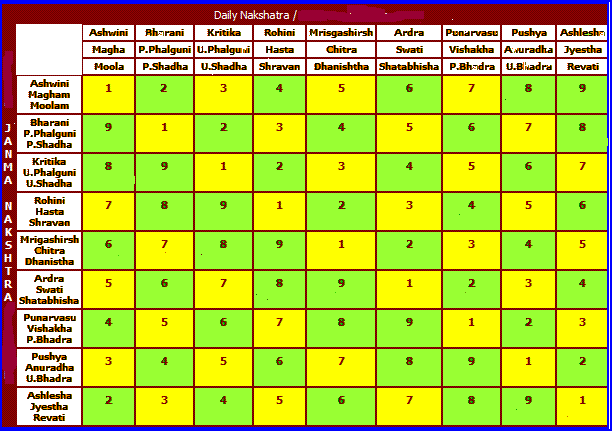
Tarabala is the strength provided by stars to your Janma Nakshatra / Birth star. Moon’s daily star / Nakshatra position needs to be favourable for casting any Mahurtha. Daily motion of moon from your Janma Nakshatra decides this strength. As moon transits into different stars it becomes favourable or unfavourable to your birth star. 27 Nakshatras are divided into three sets of 9 Nakshatras. Each part / set is called Paryaya /Navakas. To calculate Tarabala one must calculate position of daily Nakshatra from your Janma Nakshatra (both Nakshatra inclusive). Divide that by 9. If the reminder is 2, 4, 6, 8 & 9 (or 0) then it’s good otherwise it’s bad.How to use the Tarabala Table
- Determine your Janma Nakshatra (Birth Star) and Nakshatra in which Moon is posited for the day.
- Locate Janma Nakshatra from the left hand side column of the table
- Locate daily Nakshatra from the top row of the table
- Find where both intersect – block, Green or Yellow
- That’s your Tarabala
- If the color is yellow or value indicated are 1,3,5,7 then they are not good.
- If the color is green or value indicated are 2,4,6,8, or 9 then they are very good.
Example:
- If your Janma Nakshatra (Birth star) is Aswini and today’s star is Revati, the Tarabala is 9 (Very good). But if birth star is Revati and today’s star is Aswini, your Tarabala for today will be 2 (Very good).
- Let’s take second example. If your star is Vaishaka and today’s Nakshatra is Chitra your Tarabala will be 8 (good). But if your star was Chitra and today’s star was Vaishaka your Tarabala will be 3 (Bad).
Tarabala Explained
Important Points
- Tarabala is a basic step in starting an important event.
- Casting of Mahurtha chart is very important.
- Mahurtha is possible even during the bad Tarabala by doing suitable Dosha Pariharas
- See the list of Pariharas down below.
- While deciding Mahurtha in case the Tarabala happens to be bad (1,3,5 and 7) and the Tara falls in First Paryaya for Janma Tara, Second Paryaya for Vipat Tara, and Third Paryaya for Pratyak Tara and in any Paryaya for Naidhana, then it has to be discarded.No Pariharas will work.
- If Mahurtha chart is strong and all planets are well posited, then it will counter many Doshas.
Pariharas
In cases where we do not get Tarabala for any Mahurtha, we can still proceed ahead by doing following Pariharas- Janma Tara Dosha – Donate vegetables like yellow Pumpkin /Leafy Vegetable,
- Vipat Tara Dosha – Donate Jaggery
- Pratyak Tara Dosha – Donate Salt
- Naidhana Tara Dosha – It should be avoided but If inevitable donate Til (Sesame seed) along with gold.
Chandrabala
- Count from your Janma Rashi to the Rashi in which the Moon is posited on the day of event.
- If the count is 1, 3, 6, 7, 10, 11 then you are said to have Chandrabala.
- 8th count (Astama Chandra) should be avoided.
Panchaka
- Note the number of Thithi. Prathama is 1; Dwitiya is 2 & so on.
- Note the number of week day. Sunday 1, Monday 2 & so on.
- Note the number of Nakshatra of the day. Ashwini 1, Bharani 2 & so on.
- Note the number of Mahurtha Lagna. Aries 1, Taurus 2 & so on.
- Add all the four above.
- Divide the total by 9
-
If the remainder is 1,2,4,6, or 8 then it indicate bad results as follows:
- 1 (Mrithyu Panchaka) – Danger & to be avoided.
- 2 (Agni Panchaka) – Danger from fire.
- 4 (Raja Panchaka) – Evil /bad results.
- 6 (Chora Panchaka) – Evil happenings.
- 8 (Roga Panchaka) – Bad results / disease.
References
1. Mahurtha Chintamani
2. Mahurtha Deepika
3. Mahurtha Darpana
Mahalaya Amavasya
12 SepMahalaya Amavasya
Mahalaya Amavasya is the new moon day of Pitru Paksha or Mahalaya Paksha, the fortnight {The dark fortnight of Aswayuja (September-October)} which is specially sacred for offering oblations or Tarpanam to the departed ancestors. It is believed that performing Tarpanam during the auspicious Mahalaya Paksha will bless your ancestors and will free them from all their sins. Each day in the Mahalaya Paksha is ruled by a particular Tithi or Moon Phase and the benefits of offering Tarpanam on each day are different. Mahalaya Amavasya is the last day of the Mahalaya Paksha , which is considered as the most important day in the year for performing obsequies and rites and on this day people donate food, clothes etc. Mahalaya Paksha – The Legend of Karna The story why the Pitru Paksha is marked by Daan and charity has its deep ingrained meaning in a story of the Mahabharata. When Karna died in the epic Mahabharata war, his soul moved to heaven, where he was offered gold and jewels as food. Karna had done limitless charity of wealth, but had neglected to do Anna-Dana. Hence he found wealth and luxuries, but with no food to appease him. Lord Yama then told Karna that he had donated gold all his life, but had never donated food to his ancestors in Shraaddh. Hence to make amends, Karna was permitted to return to earth for a fifteen day period, so that he could perform Shraaddh and donate food and water in their memory. This period is now known as Pitru Paksha. It is believed that in these 15 days the souls of our ancestors are the closest to the earth, moving around us and if we fail to recognize them, they return to their abode unsatisfied and unhappy that we did nothing for them. Significance of Donating Food during Mahalaya Paksha The easiest way to access God’s grace is to feed a famished human starving for food. Donating food is considered to be the greatest charity of all the charities and it is believed that whoever donates food will attain an ‘elevated status’. When to give Tarpanam The fifteen days of Mahalaya Paksha consists of 15 Tithi. They are Pratipath, Dwitiya, Tritiya, Chaturthi, Panchami, Shasti, Asthami, Navami, Dashami, Ekadashi, Dwadhashi, Trayodashi, Chaturdashi and New Moon day (Sarvapitru Amavasya). According to Hindu mythology, every individual who wants to perform this Pitru Tarpanam should do it on the same day his ancestor died which will fall within any one of these fifteen days. Mahalaya Amavasya – 2011 The Amavasya in September 2011 marks the end of the Pitru Paksha and is known as Mahalaya Amavasya and falls on 27 September 2011. The Amavasya Time begins at 07:29 PM on September 26 and ends at 05:13 PM on September 27. Navaratri festival commence from 28 September 2011. Traditional Durga Pooja rituals also commence on this day. As per traditional North Indian calendar it is the Amavasya in Ashwin month. In other regions, as per traditional calendars followed in Maharashtra, Gujarat, Andhra Pradesh and Karnataka, Bhadrapada month ends on that day.Aridra Pravesha
29 JunSaptanadi Chakra
1. Saptanadi Chakra is very useful in prediction of weather, especially for rainfall. There are two variants based on two ancient sources of Saptanadi Chakram: Narapati Jayacharyā and Krishi-Parāshara and all later texts are based on them. The original source of Saptanadi Chakra was a Tantric text titled ‘Yāmaleeya-Svarodaya’. 2. There are 27 Nakshatra for the purpose of astro-meteorology. Apart from these, the 28th Nakshatra ‘Abhijit’ is also allotted a space towards the end of Uttarashada. 3. These Nakshatras are subdivided into 7 Nadis starting from ‘Krittika’ (3rd Nakshatra) as ‘Vat Nadi’ followed by ‘Ativat’, ‘Dahan’, ‘Soumya’, ‘Neera’, ‘Jala’ and ‘Amrita’ and the sequence continues as shown in the diagram below. The sequence follows a serpentine pattern. This is called ‘Saptanadi Chakra’ 4. Vat produces windy weather, Ativat produces cold, Dahan increases temperature, and Soumya, Neera, Jala and Amrita nadis are rain producing. Parashara method of prediction • Each Samvatsara has Nava Nayakas and a particular planet as a ruler, another planet as a minister, and another planet as ruler of cloud, and depending on the formation of these grouping of planets; one can study the amount of rainfall. • The following chart gives the results of different planets being the Ruler of the year.
• If the entry of Sun in Aridra Nakshatra happens after sunset and before the next Sun rise, it is good for rainfall and weather.
• All other times are considered inauspicious. Solar entry in Aridra Nakshatra between sunrise and 12 noon is especially bad and points towards coming famine.
• Sun entering Ardra during late evening or night indicates widespread and plentiful rainfall leading to good crops and easy availability of food grains.
Varahmihir’s Principles of Weather forecast:
•Aswini, Krittika, Rohini, Purvabhadra, Uttarabhadra, Anuradha, Sravana, Punarvasu and Pushya are masculine Nakshatras.
• Bharani, Hasta, Chitra, Swati, Visakha, Purva, Uttara, Aslesha, Magha, Jyeshta, Aridra, Dhanista, Purvashadha and Revati are feminine Nakshatras.
• Satabhisha, Mrigasira and Moola are neutral.
• When the Sun and the Moon are in neutral Nakshatras there will be winds.
• When they are in feminine Nakshatras there will be lightning and thunderstorms.
• When the Sun occupies a feminine Nakshatra and the Moon a masculine one or vice-versa there will be rains.
• When many planets are in one Rashi, preferably in one Nakshatra, it affects the weather.
• When many planets gather in one Rashi with Mars and Sun joining them and Mars is with Rahu, there can be a terrible downpour.
• When there is concentration of planets in one Rashi, the weather begins to fluctuate and if Moon joins them, there will be heavy downpour.
• When Mars transits from one Rashi into another within two days there is a perceptible change in weather and in the rainy season there will be good rainfall. Mars is the most powerful planet causing rainfall.
• Cancer, Pisces and Capricorn are full watery signs; Taurus, Leo and Aquarius are half watery signs; Aries, Libra and Scorpio are quarter watery signs while Gemini, Virgo and Sagittarius are non watery signs.
• Moon and Venus are full-blown watery planets.
• During Dakshinayana malefic planets (Saturn, Sun, and Mars) transiting through the Amrita, Jala and Neera Nadi, would give rise to ordinary rains.
• If benefic planets transit the above constellations, there will be plenty of rain.
Predictions for the Year 2011
For this we have to cast a chart when the Sun enters Aridra Nakshatra. In this year Sun entered Aridra Nakshatra at 1606 hrs on 22 June 2011 and the chart below is cast for New Delhi for that day and time.
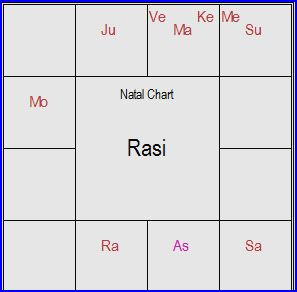
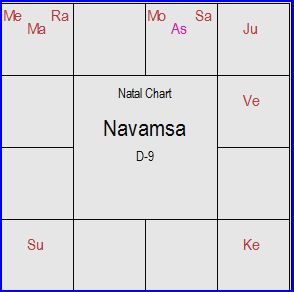
Lagna: Libra, Moon: P’Bhadra 2, Mars: Krittika 4, Mercury: Aridra 4, Jupiter: Ashwini 3, Venus: Rohini 4, Saturn: Hasta 2 and Rahu: Jyeshta 4 / Ketu: Mrigashira 2 Placement in Saptanadi Chakra Sun, Mercury & Saturn: Soumya Nadi, Moon: Neera Nadi, Mars: Vat Nadi, Jupiter ,Venus & Rahu: Ativat Nadi and Ketu: Dahan Nadi Analysis 1. For Kharanama Samvatsara, ruler of the year is Moon, Mantri is Jupiter and Megadhipa is Mercury and this combination should give heavy rains and good harvest. 2. In the chart, Lagna is Libra, a quarter watery sign and Lagna Lord is Venus is a full watery planet. Due to its placement in 8th house the rainfall may not be full / heavy. Also Lagna is in Papakartari yoga surrounded by Rahu & Saturn. Jupiter a benefic aspecting Lagna will bring some relief. Eastern region will get good rains. 3. Moon being a watery planet posited in Aquarius and Neera Nadi indicates plenty and timely rainfall. In Navamsha chart, Moon though posited in Navamsha Lagna and in Taurus, a half watery sign, might not give enough rains because of its placement in 8th Amsha vis-à-vis Rashi Lagna. 4. The south west direction has as many as five planets in Aridra Pravesha chart. Mars, Venus, Ketu, Sun and Mercury there will give erratic monsoon for the places in this direction. Kerala, Karnataka, Goa and Maharashtra may not have good rains because malefic planets overweigh benefic planets. 5. Mars and Saturn aspect on Rahu indicates heavy rains for North eastern region. 6. As per Saptanadi Chakra, 5 planets in first three Nadis (Vat, Ativat & Dahan), three in Soumya Nadi and only one planet Moon in last three Nadis (Neera, Jala & Amrita) indicates high winds and arid conditions and we may not see heavy rains during next one month. 7. Over the period of next three months we have to watch the transit of Sun, Moon, Mars, Mercury and Venus to gauge the total rainfall. Usually charts are cast for ingress of Sun into different sign and interpretation has to be made for each month. Author’s Note Mundane Astrology is a vast subject and encompasses an array of topics like prediction of weather, rainfall, earthquakes, national disasters like floods / fires /major accidents, epidemics etc. What I have touched upon is only the rainfall aspect and serious students have to do concerted and diligent research to master the subject in toto. Following classic / books may be used for reference:1. Brihat Samhita by Varahamihira
2. Applied Astrology by KN Rao
3.Time Tested Techniques of Mundane Astrology by MS Mehta and A Radhika
4. Astrology in Predicting Weather and Earthquakes by BV Raman.
5. Mundane Astrology by KB Gopalakrishnan.
6. Raphael’s Mundane Astrology by Raphael
7. Mundane or National Astrology by HS Green
Aide Memoire for Mahurtha
21 JunOm Gurubyo Namaha
Aide Memoire for Mahurtha
While selecting a suitable day and time for any undertaking, the prevalent Thithi (Lunar day), Nakshatra (Star constellation in which the Moon is placed at that time) and the Yoga (auspiciousness) are taken into consideration. If you don’t have an astrologer to guide you, the following basic information will help you. Please note that in Vedic Astrology everything has its functional use. Some days may be auspicious for some things, but inauspicious for other things. The following points will help you to fix simple Mahutha.15 Thithis
1. From Sun rise to next day Sun rise is one Thithi. 2. The Thithi prevailing at the time of Sun rise will be taken as the Thithi for the day. 3. There are 30 Thithis in a month counted as 15 of Shukla Paksha and 15 of Krishna Paksha. 4. The Thithis are classified as follows:- 1, 6 & 11 – Nanda
- 2, 7 & 12 – Bhadra
- 3, 8 & 13 – Jaya
- 4, 9 & 14 – Rikta
- 5,10 &15 – Poorna
1st Thithi – Pratipath – The presiding deity of the first Thithi in Brahma / Agni and is good for all types of auspicious and religious ceremonies. 2nd Thithi – Dwitiya – Vidhata / Brahma rules this Thithi and is good for the laying of foundations for buildings and other things of a permanent nature. 3rd Thithi – Tritiya – Vishnu / Gauri is the lord of this day and is good for the cuttings of one’s hair and nails and shaving. 4th Thithi – Chaturthi – Ganesha / Yama is the lord of the 4th Thithi, which is good for the destruction of one’s enemies, the removal of obstacles, and acts of combat. 5th Thithi – Panchami – The Moon / Sarpa rules this day, which is favourable for administering medicine, the purging of poisons, and surgery. 6th Thithi – Shasti – Karthikeya presides over this day and is favourable for coronations, meeting new friends, festivities, and enjoyment. 7th Thithi – Sapthami – The 7th Thithi is ruled by Indra /Ravi one may begin a journey, buy conveyances, and deal with other such things as a movable nature. 8th Thithi – Asthami – The Vasus / Shiva rule this day, which is good for taking up arms, building of one’s defenses and fortification. 9th Thithi – Navami – The Serpent / Durga rules this day, with is suitable for killing enemies, acts of destruction and violence. 10th Thithi – Dashami – The day is ruled by Dharma and is auspicious for acts of virtue, religious functions, spiritual practices and other pious activities. 11th Thithi – Ekadashi – Rudra / Viswa Devas rules this day; fasting, devotional activities, and remembrance of the Supreme Lord are very favourable. 12th Thithi – Dwadhashi – The Savitri / Vishnu rules this day, which is auspicious for religious ceremonies the lighting of the sacred fire and the performance of one’s duties. 13th Thithi – Trayodashi – The day is ruled by Cupid and is good for forming friendships, sensual pleasures, and festivities.
14th Thithi – Chaturdashi – Kali / Shiva rules this day suitable for administering poison and calling of elementals and spirits.
15th Thithi – Amavasya or Poornima – The Vaisva-devas / Moon rule the New Moon and is suitable for the propitiation of the Devas and performance of austerities. Note: There are 4 important tithis which do not require any Mahurtha, since each of the entire tithi is considered good. Any important work like wedding etc. can be done on these tithis. These are: 1 Chaitra Shukla Pratipath (Prathama)2 Akshaya Tritiya
3 Vijaya Dashami
4 Karthika Shukla Pratipath (Prathama)
27 Nakshatras
The Nakshatra are divided into following categories: 1. Dhruva /Sthira (Fixed): Rohini, Uttaraphalguni, Uttarashada, and Uttarabhadrapada are in this category and are favourable for digging wells, laying foundations or cities, expiatory rituals, planting trees, coronations, buying lands, meritorious deeds, sowing of seeds, installation of Deities, the building of a temple, or any other activity desirous of a lasting or permanent effect. 2. Mridu / Maitreya (Soft / Gentle): Mrigasira, Chitra, Anuradha, and Revati belong to this category and are good for fine arts, learning, making friendships, sensual pleasures, decorations, sexual union, wearing new apparel, marriage, singing and dancing, processions, auspicious ceremonies, festivities, dealings of agriculture, and journeys. 3. Kshipra / Laghu (light / Swift): Ashwini, Pushya, and Hasta are good for sports, enjoying items of luxury, starting industries, skilled Labour, medical treatments, starting education, starting journeys, seeing friends, buying and selling, the performance of spiritual activities, decorations, fine arts, exercise, and for giving or receiving loans. 4. Teekshna / Daruna (Dreadful): Aridra, Aslesha, Jyeshta, and Moola are suitable for success in warfare, invocation of elementals and other spirits, imprisonment, separations, acts of destruction, and the breaking of alliances with superiors. 5. Chara / Chala (Movable / Quick): Punarvasu, Swati, Shravana, Dhanista and Satabhisha are stars favourable for undertaking travel, acquiring conveyances, gardening, going on processions, visiting friends, and anything of a temporary nature. 6. Ugra / Kroora Fierce / Cruel): Bharani, Magha, Purvaphalguni, Purvashadha, and Purvabhadrapada are suitable for acts of evil, deceit, and conflict, destruction of enemies, incarceration, poisoning, arson, battle, setting fire, acts of destruction, ill-repute, and cruelty. 7. Mishra / Sadharana (Mixed): Krittika and Visakha are good for routine duties, one’s professional responsibilities, and any activities of day-to-day importance. Dagdha Nakshatras: The following Nakshatras are considered inauspicious for commencing any new work or venture, if they fall on the days as given below:Sunday – Bharani
Monday – Chitra
Tuesday – Uttarashadha
Wednesday – Dhanishtha
Thursday – Uttaraphalguni
Friday – Jyeshtha
Saturday – Revati
27 Yogas
Yogas are of two types: 1. Naisargika Yoga 2. Tatkalika Yoga Naisargika Yogas: !. Vishkambha (Supported) — prevails over others, victorious over enemies, obtains property, wealthy. 2. Priti (Fondness) — well-liked, attracted to the opposite sex, enjoys life with contentment. 3. Ayushman (Long-lived) — good health and longevity, energetic. 4. Saubhagya (Good Fortune) — enjoys a comfortable life full of opportunities, 5. Shobhana (Splendor) — lustrous body and demeanor, sensualist, obsessed with sex. 6. Atiganda (Danger or obstacles) — difficult life due to numerous obstacles and accidents; revengeful and angry. 7. Sukarma (Virtuous) — performs noble deeds, magnanimous and charitable, wealthy. 8. Dhriti (Determination) — enjoys the wealth, goods and spouses of others; indulges in the hospitality of others. 9. Shoola (Spear, Pain) — confrontational and contrary, quarrelsome, angry. 10. Ganda (Danger or obstacles) — flawed morals or ethics, troublesome personality. 11. Vriddhi (Growth) — intelligent, opportunistic and discerning;life constantly improves with age. 12. Dhruva (Constant) — steady character, able to concentrate and persist, wealthy. 13. Vyaghata (Beating) — cruel, intent on harming others. 14. Harshana (Thrilling) — intelligent, delights in merriment and humor. 15. Vajra (Diamond, Thunderbolt) — well-off, lecherous, unpredictable, forceful. 16. Siddhi (Success) — skillful and accomplished in several areas; protector and supporter of others. 17. Vyatipata (Calamity) — prone to sudden mishaps and reversals, fickle and unreliable. 18. Variyan (Comfort) — loves ease and luxury, lazy, lascivious. 19. Parigha (Obstruction) — encounters many obstacles to progress in life; irritable and meddlesome. 20. Shiva (Auspicious) — honored by superiors and government, placid, learned and religious, wealthy. 21. Siddha (Accomplished) — accommodating personality, pleasant nature, interest in ritual and spirituality. 22. Sadhya (Amenable) — well behaved, accomplished manners and etiquette. 23. Shubha (Auspicious) — lustrous body and personality, but problems with health; wealthy, irritable. 24. Shukla (Bright White) — garrulous and flighty, impatient and impulsive; unsteady and changeable mind. 25. Brahma (Priest, God) — trustworthy and confidential, ambitious, good discernment and judgment. 26. Indra (Chief) — interest in education and knowledge; helpful, well-off. 27. Vaidhriti (Poor Support) — critical, scheming nature; powerful and overwhelming mentally or physically. Note: 1. Naisargika Yogas remain in the same order and is operative for each day. 2. Vyatipata and Vaidhriti should be avoided for all auspicious occasions. Tatkalika Yogas 1. Takalika Yogas are formed by a special combination of thithi-vara-nakashatra. 2. These yogas give results according to the meanings of their names. For example, Siddhi, Amrita, Dagdha, Visha, Mrithyu, yamagandka etc., 3. Bhadra Thithi (2, 7 & 12) on Wednesday gives Siddhi Yoga 4. Jaya Thithi (3, 8 &13) on Wednesday gives Amrita Yoga 5. Trithiya on Wednesday causes Dagdha Yoga 6. Dwitiya on Wednesday causes Visha Yoga